Showing posts sorted by relevance for query Braddock. Sort by date Show all posts

Tuesday, February 26, 2013

Iconic Towns of the Mon Valley: Braddock, PA

 It's interesting how Duquesne and Braddock stare at each other across the Monongahela River, like the ancient foes that their namesakes were.  (Duquesne was the governor of New France, and Braddock was the British general who was sent to oust French forces from the region.)  For years I've dreamed of Braddock.  I always imagined that it's the ultimate in urban ghost-towning destinations.  The town's utter collapse and subsequent attempts at revival have attracted the attention of everyone from the editors of The New York Times to The Colbert Report.  This is the legendary city as seen from across the Mon.  
 Braddock did not disappoint me, but it did surprise me.  I expected bleak expanses of "urban prairie," utter desolation, warehouses, and thickets, and roving packs of feral dogs.  But, despite a great many abandoned buildings, the place is not lifeless.  Nor is it ugly.  It's situated pleasantly on the hillsides above the river.  The streets have a nice feng shui to them, too.  In its disrepair, you might describe  the place as "wabisabi."  
 It's definitely an old factory town, with lines of identical rowhouses, steep streets, and a weed-choked riverfront.  And yet, there's a kind of enduring character to the place.  The whole town is built to a human scale.  It's walkable, with sidewalks and good proximity.  Its public buildings display the lovely architecture that used to keep life rich and mysterious.  Not everyone was educated in the Braddock of old, but everyone had easy and equal access to beauty.  
 And it's not all working class neighborhoods.  A few graceful mansions still stand on the heights above the main street, Braddock Avenue.  You've actually got three separate municipalities all blurred together in this stretch of the valley: Braddock, North Braddock, and Braddock Hills.  I'm not really sure where one begins and the other ends, but they've all got a similar feel.  Maybe we should call this general area "The Braddocks" in the same way people refer to "The Hamptons."   
 Braddock's famous decline has been memorialized by a series of Levi's Jeans ads.  In fact, George Romero (of zombie fame) made his least grotesque movie here in Braddock in 1978, and even at that time, the town's decline was a major factor in the story's plot.   It's a vampire film called Martin, and in it, the old town is still very recognizable.  
 Unlike the other half-empty towns of the Monongahela Valley, Braddock is still home to a bustling steel factory.  In this town, all roads lead to US Steel's Edgar Thomson plant, the oldest and last surviving steel factory in the region.  Of course, the mill employs far fewer steelworkers than it did in former times.  And because the jobs pay well, few if any of the workers choose to live in Braddock.  All the same, there's a kind of movement here that Duquesne lacks.  Trucks go rumbling past.  Cars pass along the main drag.  
 It was probably pretty bad juju to name a city after the ill-fated General Edward Braddock, whose 1755 defeat took place on the town site, at the hands of a much smaller French and Indian army.  When the old factory was being built--in the late 1800s--it's said that the workmen discovered many English skeletons still strewn about in the forest.  Braddock died of wounds he sustained in battle and is buried south of here.  By all accounts, he was an arrogant, inflexible bastard.  Most histories report that his disgraceful defeat was the result of his poor treatment of Indian allies and his refusal to respect the opinions of colonials.  
 The public library in Braddock was the first "Carnegie Library" in America.  It's still one of the busiest, most appealing places in town.   
 Some few streets look relatively typical of urban Southwestern Pennsylvania: densely spaced houses, a little rundown, but nothing worthy of this town's sinister acclaim.  
To me, this is the most intriguing house in a most intriguing city.  It's an old wooden Victorian mansion on the heights above downtown.  The porches are all stacked with debris: old furniture, boxes, lawn tools, machinery, all detritus of bygone years.  The yard is enclosed with a fence, and there's a "No Trespassing" sign at one of the gates.  Check out the photo below for a glimpse of the trash-laden porches.
Braddock is more compact than Duquesne.  It might even feel less destitute than its neighbor across the river, and there's a clear sense of community pride here.  Its upper streets and alleys are rich with stories.  Old, old stories that will never again be told.  I really need to come back here for another, longer visit.  

Tuesday, December 31, 2013

Braddock's Grave

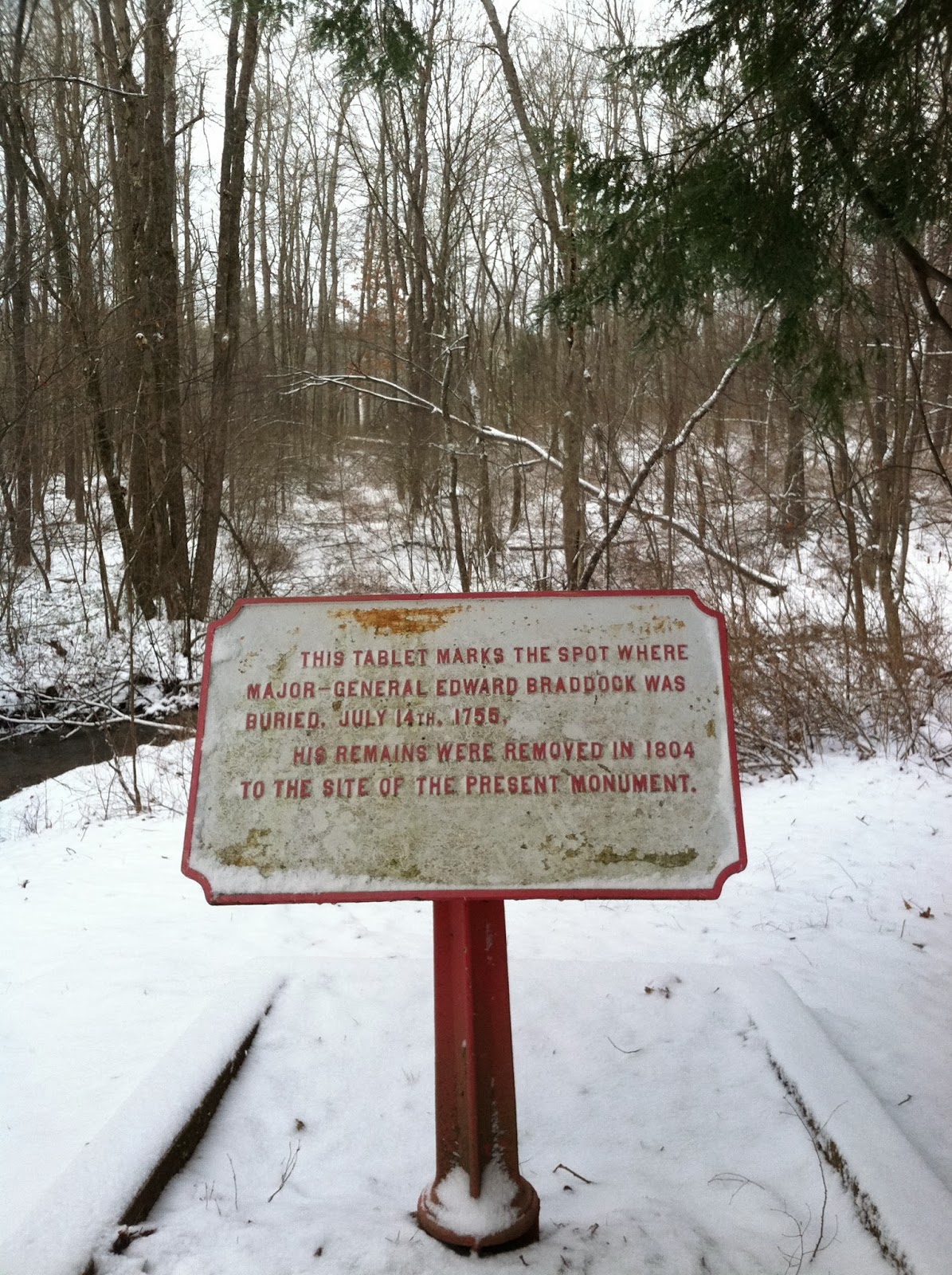
This is the lonely roadside grave of the once-famous General Edward Braddock, who was killed in the summer of 1755 in the earliest days of the French and Indian War.  The grave is along US Highway 40, also known as "The National Road," in the mountains just above Uniontown, PA.
The Scottish general was ambushed and turned back at the Battle of the Monongahela, at the present-day location of the equally ill-fated town bearing the man's name: Braddock, PA.  He and his decimated army retreated, but Braddock died the next day.  His body was buried here, beneath the road, for fear that Indians would find it and dismember it.  A young George Washington officiated at Braddock's interment, reading the graveside burial service from the Anglican Book of Common Prayer.   
The French and Indian War is really the formative narrative of Western Pennsylvania.  It's deep in our identity.  Long before coal, or steel, or Andrew Carnegie, there was just this lane through the trees, a place where empires clashed.  In several places, short segments of Braddock's Road can still be traced out.  Much of US 40 runs more or less parallel to the old road that Braddock and his English forces carved out of the wilderness en route to attack the French forces garrisoned at Pittsburgh.  Click on any photo to enlarge it.

Saturday, February 27, 2016

Ohiopyle Legends and Tom Faucet's Grave

Ohiopyle Legends

Call me a dork, but I didn't think it was too early to book campsites for the annual Memorial Day weekend excursion with friends.  I actually convinced everyone to go a little further afield than Raccoon Creek this year.  This is Ohiopyle in the snow.  I trekked about a mile down the frozen campground road to look over the sites and see which ones I liked best in order to book them.  The Kentuck Campground at Ohiopyle is wooded and beautiful, and the Laurel Highlands have so much to offer.  Tubing, rafting, kayaking, biking, fantastic hiking, great views like this one.  The only drawback is that swimming is about 15 miles away, at Laurel Hill.
Good thing I gave myself several options; when I got home I discovered that all my favorite sites had already been booked.  This is not the case nearby at Raccoon Creek, where the four best sites are still available.  But Ohiopyle is THE outdoor destination around here, so people must book early.  We were lucky to get a few acceptable sites that were adjacent to each other.  The Laurel Highlands are Pittsburgh's equivalent to New York City's Catskills--not the closest patch of woods, but definitely the closest bit of wilderness.  Anyway, I'm glad I had to walk into the wintry campground on foot; otherwise I might have missed this strange little trail to an old cemetery.
The infamous frontier ruffian, Tom Faucet, is buried at the end of this path, and here's a little plaque to commemorate his boasts and misdeeds.  Of course, Faucet became a prominent name in Western Pennsylvania.  There's an old Methodist church near my house that was founded in 1812 and named after the Faucets.  I'd long heard that old Tom bragged about killing Braddock, his own commander in the French and Indian War.  Little did I know he was buried in Ohiopyle State Park.  Click on this photo to read the tale.
Here's the fellow's grave, the stone dating back to 1822.  Of course, if he actually did shoot Braddock in the back, it was all the way back in 1755.  He lived a long and fairly prosperous life after murdering the ruthless Scotsman.  By all accounts, one of the reasons for Braddock's failure to rout the French from Fort Duquesne was his refusal to respect his colonial and Indian soldiers.  He treated them with arrogance and disdain, ignoring their counsel and often resorting to public shaming and physical abuse of his own men.
Now, I don't believe in ghosts.  Really, I don't.  But I grew up in a pretty superstitious environment, so I occasionally think about spooky things.  Standing there in the snow of this neglected old graveyard, I spoke to Tom.  It was a relatively windless day up in the mountains, and I said, "How about it, Tom?  Did you really kill old Braddock?  Two strong gusts if you did!"  I waited a moment, and out of the still sky, suddenly the treetops began to creak and rattle in a surge of wind.  It stopped, and I said, "Okay, that's one."  But no sooner had I said this than another gust of wind shook the forest.  Then all was still.  I was a little spooked, so I said, "Well done, my friend.  I hear Braddock was a jackass."  Then I hurried away.  
Of course I don't honestly approve of the murder of General Braddock, if indeed he was murdered.  But if old Tom would shoot his own commanding officer in the back, then I didn't assume he'd much fancy a sermon from the likes of me.  I know this story sounds apocryphal, but I swear it's true.  Here's a little unmarked church not too far from the cemetery.  I wonder if this is where his funeral was held?  I peeked inside, and it looks like it's still used from time to time: pulpit, lectern, piano, pews, hymnals, a framed print of the Last Supper.  I wonder if this is now a chapel for the Ohiopyle campground.

Tuesday, February 26, 2013

Iconic Towns of the Mon Valley: Duquesne, PA

 Instead of a rural wilderness trek, today I opted for an urban adventure.  For a long time, I've been curious about the old mill towns of the Monongahela Valley. Many of them are semi-ghost towns, but their names loom large in local legend: Homestead, McKeesport, Braddock, Clairton.  These were never "suburbs" of Pittsburgh, but proud satellite cities with distinctive identities in the region.  First stop: Duquesne.  
This is Holy Trinity Roman Catholic Church, on South First Street.  It's scheduled for demolition in the summer of 2013.
 Duquesne was largely settled by Eastern Europeans who came to work in the steel mills.  You still see a few elderly white folks milling about in doorways, but now the town is mainly African American.  I saw a beautiful old yellow brick house for sale in this part of town: $12,000.  According to the real estate website, the place needs some "finishing touches" but it's entirely ready to move into.  (Maybe in Duquesne replacing shattered windows is considered a finishing touch.)  This town seems ripe for the kind of urban reclamation projects we've seen in Homestead and even Braddock.  All it takes is people who care and who are willing to commit...and who have some money to invest.  That's the rub.
 Duquesne is designated "a distressed municipality" by the state, and it recently lost its high school, which had some of the lowest test scores in Pennsylvania.  We're talking about a place where the schools were as bad as North Philadelphia.  Duquesne has one of the highest violent crime rates in the state: 89 murders per 100,000.  That's an unimaginable statistic.  Actually, I think "distressed" is an understatement.  And yet, I liked the place.  In all its wretchedness, it has an almost welcoming, livable feel to it.  
 Like all the great towns along the Monongahela River, Duquesne was dominated by a steel mill for about 100 years. The factory ceased operations in 1984, and Duquesne lost its reason for being.   
 I would guess that almost half the houses in town sit empty.  Most storefronts are derelict, too. And yet, there are stubborn signs of life even here.  A few tenacious businesses still hold out on the main drag, Grant Avenue: a hardware store, a tailor shop, a number of dubious-looking bars.  
 Many grand old churches and public buildings are now occupied by small, evangelical sects with name's like "Abundant Faith in Christ Assembly Church."  I felt a little nervous in some neighborhoods, just because I'm a paranoid outlander from up north.  But really, the people went about their business and let me go about mine, which was to poke around the wreckage of their town.  There's a sort of kindness in tolerating a stranger with a camera.  
 In many places, you can see what a pleasant town it was in its day.  Gentle hills give a contour to the cityscape, offering views of the river valley and the wooded hills on the opposite bank.  Tree-lined streets speak of happier times when children played and lawnmowers hummed.  
 This is the Lithuanian Club.  Like many buildings in town, you can't quite tell whether it's abandoned or just neglected.  I'm guessing the former, since the Lithuanians all moved out to Peters Township twenty years ago.  
 Looking off to the northeast, above the rooftops of empty houses, you can see the Edgar Thomson steelworks in Braddock.  Clairton is still home to an enormous "coke works" plant, but Braddock has the first and the last of the great steel factories in the valley...still plugging away.
 Down by the banks of the Monongahela River is a broad, flat area where Duquesne's steel mill used to sit.  At its height of productivity, 8,000 men were employed at this factory--more people than live in the city today.  Now the riverside flats are an industrial park.  The Steel Valley Trail segment of the "Great Allegheny Passage" follows an old railroad grade through here.  This shot looks from the riverbank toward the City of Duquesne in the distance.  
 An enormous railroad yard separates the grittiest parts of town--to the south--from the still-gritty-but-not-entirely-destitute-neighborhoods to the north.  This rundown mansion sits across the street from the Presbyterian church: evidence that even Duquesne has a handful of fading WASPs.  It's strange, in this northern segment of town, to see the rollercoasters of Kennywood poking their playful heads above such an otherwise grim landscape, under gray and wintry skies.  
Also north of the tracks, a block of homes almost reminiscent of the genteel Squirrel Hill neighborhood in  Pittsburgh.  
   Out along the edges of town are crowded little areas of tiny brick Cape Cods.  Many of them are decorated with Steelers paraphernalia: evidence of working class whites.   There's a forlorn beauty to this town, especially the older segments, despite--or perhaps because of--the post-apocalyptic abandon.  In less than forty years, this place has become a shell of itself.  It's a study in collapse, which is all very appealing to a melancholy trespasser like me.  
(Click on any photo to enlarge it.) 

Saturday, August 19, 2017

Braddock, as Seen from The Phantom's Revenge

 My rule at the top of all the scariest Kennywood rides is to look for Braddock.  Is the rollercoaster nearing the top of the rise?  Is it going to plunge insanely fast into gut-wrenching depths?  Are you mind-bogglingly higher than you would ever allow yourself to go on roofs, or ladders, or under any sane circumstances?  Is everyone around you screaming like a madman?  Stay calm and scan the horizon for the grand old town of Braddock.
How do you know which one is Braddock?  It'll be the one with Pittsburgh's last steel mill, just across the Monongahela River.  Just look for the smoke.  The whole region used to look like this place.  All the riverfronts in the city were crowded with factories and train tracks and smokestacks, belching clouds of noxious gray poison.  A far better way to spend a late summer afternoon is in the Monongahela National Forest of West Virginia.  Find those amazing photos by clicking here.  It's actually been a really great summer--despite the fact that Trump is still President--with far more trips than usual.  Photos from another Outer Banks adventure are here

Monday, March 18, 2024

Fort Necessity National Battlefield


Sunday afternoon, with the family all gone away their different directions, I decided to bag one more peak before my Secret Peak-Bagging Nemesis got to it.  (Anonymous carpetbagger from New York State who comes down here to claim all the easy peaks without even honoring them with a quick description or a single photo!)  It had to be a mountain near Pittsburgh because I only had a few hours to complete the task.  So I trained my eagle-eye on one Hager Hill, which is inside the Fort Necessity National Battlefield.  Here’s a shot of the reconstructed fort, which a young George Washington hastily improvised in 1754 in a place called Grassy Meadow.


And here’s the viewless vista from the summit of Necessity Hill, which stands at a respectable 2,120 feet.  Necessity Hill is the ridge just above the fort, and it’s the peak I ended up bagging, but it’s not Hager Hill.  Also, two other members of my peak-bagging club had already been there, so I did not get to claim “First Ascent.”  I will not tell you whether one of them was indeed my Secret Peak-Bagging Nemesis.  


I brought my daughters here many years ago, when they were little.  I tried to inspire a sort of “pride of place” in them.  I showed them Jumonville Glenn, where Washington plunged the American colonies into the Seven Years’ War, which we call “The French and Indian War,” probably my favorite of all the wars—if I’m allowed to have favorites.  I showed them Braddock’s grave, where he was buried under the road after dying from his wounds while trying to take the Forks of the Ohio (Pittsburgh) from the French.  I showed them the isolated grave of one Tom Fawcett, a scoundrel and hermit who had been one of Braddock’s soldiers and who claimed that he shot Braddock in the back for being such a prick.  In this photo you see a bit of the road that Braddock hacked into the American interior.  


And of course, I showed them Fort Necessity, seen here.  I also took them downtown to the Point to see the outlines of Fort Duquesne and Fort Pitt.  I never showed them Bushy Run, or Ligonier, or Hanna’s Town, though (God help them) they are half Hanna.  When they were little, they found it all very interesting.  Now?  Well, things are different now.  They would never want to accompany me on ventures like this…


And though I managed to be the third person in my peak-bagging club to nab Necessity Hill, I did not end up bagging the yet-unclaimed Hager Hill, my original goal.  There’s no trail to it, and I did not have enough daylight to do a proper bushwhack.  Even to get to the top of Necessity Hill, you’ve got to take the trails up as high as they’ll go, then ignore the sign telling you that the lane to the top is for “Authorized Personnel Only.”  (I think it’s referring to vehicles, not foot traffic.)  There’s nothing up there but more trees, as I pointed out in the second photo above.  Maybe I’ll go back for Hager Hill someday, but it didn’t honestly look all that interesting.  Sometimes there’s a reason a peak goes unclaimed.

Wednesday, March 27, 2013

Carrie Furnace & Rankin, PA

 This is the famed Carrie Furnace, which sits derelict on the banks of the Monongahela River in Rankin, PA. At the height of its glory, the Carrie Furnace cranked out 1250 tons of iron per day.  Getting close enough to take pictures is no small task.  
 The land all around the old factory is closed off with a chain link fence and plenty of "No Trespassing" signs.  Apparently the county is redeveloping this area into a riverside park and historic site.  The plant was constructed in 1884 as part of the immense Homestead Steel Works--the bulk of which was across the river.  The Carrie Furnace was in operation until 1982, though only furnaces #6 and #7 remain.  
 Despite my thorough pre-trek research on Google Earth, it actually took some effort to find access to this place.  I ended up going back into Braddock, then following a meandering brick lane through the flat industrial wastes along the river.  You pass under the Rankin Bridge--which most Pittsburghers know as the gateway to Kennywood.  When the road ends at a gate, you park and walk down the railroad tracks.  There's a drop-off to one side of the tracks; down in that murky chasm there runs a spooky little road that seems inaccessible to cars (above photo).  This eerie pedestrian tunnel probably runs up the hillside to the workers' neighborhoods in Rankin.  The date above the entrance is 1932.  
 When Soviet leader Brezhnev visited the United States in 1973, one of the things he most wanted to see was the great Homestead Steelworks, which at the time was the largest steel factory in the world.  Aside from a line of old smokestacks in a mall parking lot across the river, this all that remains.  
 Twice, as I was walking along the tracks, trains came rumbling past and forced me into the gravelly margins.   On the trek back to the car, I tried in vain to outrun the train.  It sure feels weird to be running down the tracks with a big old Conrail locomotive barreling up behind you.  Also, there were about half a dozen workmen on the grounds of the factory, presumably turning the place into a park.  
 This is the old "Hot Metal Bridge" over the Monongahela River, as seen from a tiny city park on the hillside up in Rankin.  The Hot Metal was never a public thoroughfare; it was used solely to transport hot metal between the Carrie Furnace and the main complex of the Homestead Works.  
 For a little while, I considered ranking Rankin among the "Iconic Towns of the Mon Valley" and categorizing this article with that series (below).  But honestly, Rankin was never really one of the big satellite cities in the region.  It's not an unpleasant place.  Despite a pretty high rate of poverty, Rankin has fewer abandoned buildings than its closest neighbor, Braddock.  And some stretches of 3rd Avenue were especially nice; they reminded me of Belgium (last photo).  But the fact is that Rankin was always pretty much residential and industrial--unlike Braddock, McKeesport, Clairton, and Duquesne, which were full-scale cities in their own rights.  Rankin had the Carrie Furnace, but obviously never had much in the way of a business district, or commercial buildings, or even stately churches--aside from the onion-domed St. Michael's Orthodox.
Getting into Rankin is easier than getting out.  Most of the town's brick streets seem to come to dead ends at warehouses or small factories.  I had to follow a city bus as it wended its way through Swissvale and back to Braddock Avenue. All in all, Rankin seemed like a pleasant enough place, even if the white police officer slowed down and stared at me hard as he drove past.  

Wednesday, October 30, 2013

Braddock Cemetery, Greene County, PA

(Not to be confused with Braddock's Grave in Fayette County or the uber-cool borough of Braddock in the Monongahela Valley in Allegheny County.)