Friday, January 13, 2017

Cabins in the Woods, Forbes State Forest

This week's trek was one of my best...not in terms of natural beauty discovered, but in terms of plain old discoveries.  And adventure.  I came across a lot of privately owned cabins in the woods, all of them closed for the winter.  The one in this photo fell down a long time ago, but in the same general vicinity there is a small hamlet of hunting camps and summer homes.
 Of course, I would never vandalize or rob from places like this, but there is a certain tinge of adventure that comes of trespassing.  They're closed for the season with the assumption that the roads in to them will be impassable until spring.  (That assumption is antiquated; it was an eerie 64 degrees in the Laurel Highlands.)
This little cottage was my favorite one in the village, with its rustic porch pillars and shuttered windows.  I love a good porch where you can sit and watch the rain, preferably with the smell of wood smoke wafting from the chimney.
The owners of this cottage seemed to have a motion-activated hunting camera installed on the trunk of a nearby tree to get pictures of anyone who ventures here unbidden--like me.  Linn Run State Park must lease out the land that these cabins are built on.  But my goal wasn't to snoop on private property.  It was simply to follow the gated road that runs from the main thoroughfare through the park up to the Quarry Trail, and on to the adjacent Forbes State Forest.  This track is called Rock Run Road, and it becomes Weaver Road.  On my maps, it appeared to be an old dirt road, no longer passable to vehicles.  And boy, was that right!  In places, it's barely passable on foot.
Once past the little gaggle of cabins, the road heads southeast through sinister rocky forests, thick with jaggers.  At the summit of the ridge, this enormous rock city appeared off to the left.  It doesn't look very big in this photo, but it is an immense collection of tall boulders with craggy hollows and gullies in between.  I spent about twenty minutes exploring the place, and it was plenty spooky under gray skies with the climate-change-winds raging through the barren treetops.  It was nice that there was not so much as a speck of spray paint on these rocks, a sign that they're too remote for vandals!
 After wending and climbing and scrambling over fallen trees, the old road comes out on a marshy plateau and seems to run between old farms, long since reclaimed by the forest.  The track runs through some private land and past this little one-room cabin--which is much smaller and simpler than the ones I'd passed at the beginning of the trek.  The family name "Kalp" is painted on the goose's belly above the door.
I pressed my cellphone up against the glass just to get some idea of what the place was like inside.  What I wouldn't give just to have a one-room cabin deep in the forest!  There's not much room in there for anything but a fireplace, a table, a few chairs, and a bed.  But I wouldn't need anything more than that.  Except curtains!  I'd definitely want to close my curtains after it got dark in the forest all around.
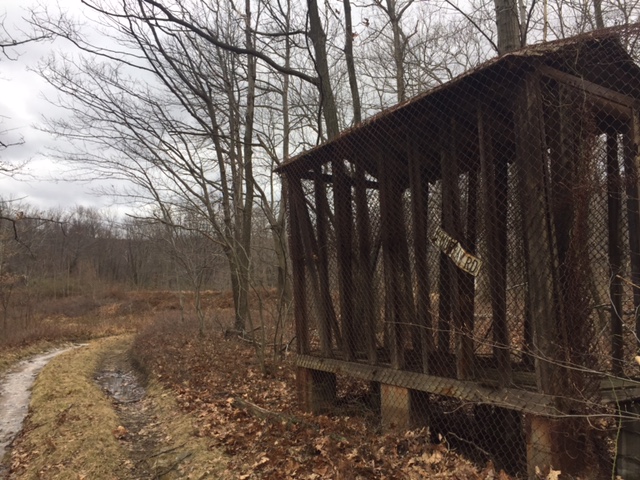
I was tempted to turn back, but something called me just a little way further down the track.  A hunch, a nameless desire, a simple longing for more of all the things my Pittsburgh life lacks.  I don't know.  The road turns very soggy and passes through more woods and comes out again into an area of old fields.  What really caught my eye was this old corn crib sitting beside the muddy road...definite proof that this place was once a farm.  The street sign inside the corn crib says McMurray Rd.
 Turn the corner, and there it is.  A two-story cabin sitting on the edge of a pond.  I approached the place with a sense of trepidation, not knowing if it was completely abandoned or currently occupied by angry drunks with AK-47s and pit bulls.
 Much to my delight and surprise, neither thing was true.  This pleasant cabin with its pond and grounds belongs to the state forest service, and an inviting little sign encourages the public to make use of it!
Someone does seem to be making use of the place, unless the Commonwealth of Pennsylvania makes it a point to stock its cabins with oversize bottles of Cuervo.  Also on the mantel were pots for cooking, dishes, and matches. 
Sure, it could use a woman's touch, but I found the cabin incredibly welcoming, with a picnic table, a few chairs, small windows looking out over the nearby pond and into the silent trees.  I could spend a few days in a place like this.  In fact, whoever left the liquor here probably comes on a snowmobile and spends a few hours away from his life (or wife?) in the winter when no one else ventures out this far into the forest.
This is the downstairs room, looking away from the fireplace.  There are two lawnmowers and a snow shovel in the far corner.  The ladder leads up to an unfinished sleeping loft.  It would be spooky to spend a night out here alone.  I would probably bolt the two doors, sit by the fire till dark, drink the Cuervo, and go upstairs to pass out on top of the plywood door to the loft--using my body weight as a lock.  It would just be too spooky trying to sleep near the fire without anything covering the windows.  Any old soul could gawk in at you while you slept...
This is looking out the window at the pond, with the patio in the foreground.  I'm thinking I need to come back to this place and spend some time here.  This whole trek reminded me of a woodland discovery I made years ago, in the wintry Allegheny National Forest.  This was a good hike; I loved discovering all these cabins, especially the last two.  But I gotta say, things like this are a lot more fun when winter is cooperating and everything is snowbound.  Imagine coming across these places in the snow, with no footprints and a real feeling of snowy isolation.

Quarry and Powder Mill Trails, Forbes State Forest

Since Christmas, I've been taking my days off down at the Forbes State Forest near Linn Run State Park, in the Laurel Highlands.  It's a 65-mile haul, but definitely worth it.  The Quarry Trail begins at an old rock quarry across the road from the park office and wends south for a few miles all the way to the Pennsylvania Turnpike, I-76.
At its southern terminus, you can hear the turnpike traffic screaming, probably half a mile distant.  But you've already got enough noise and speed in your life.  Don't go that way.  Instead, turn right (west) onto the Powder Mill Loop Trail, which takes you above a very deep valley and out into some truly remote woods with beautiful streams and pure silence...at least in the winter.  My cell phone camera cannot capture the bigness of this country--the depth of the wooded valley, the vast sweep of the mountains all around, the height of the trail above the streams below.
ATVs are not allowed on this trail, but that doesn't seem to stop them.  So...if there is any noise out here, it's probably those damnable machines.  Ah, but sometimes they come to fitting ends in the rocky hollows of the Forbes!  This bit of wreckage is probably invisible in the summer.  (As much as I gloat to see one taken off the trails, I do hope nobody got hurt.)
The Powder Mill Loop joins up with the old Felgar Road--which I've explored and talked about elsewhere on this blog.  The intersection is tricky, but when you come off the trail and onto a T at a dirt road, just make sure it's the one that runs parallel to the screaming turnpike, far below.  (Don't take the first dirt road to the left when you come up off the trail; it's a false lead.)  Ah, but take time for a quick detour!  Before following the loop to the left and downhill, first turn right on Felgar and go uphill for about a quarter mile to pay your respects at the Ritter Cemetery.
Almost all the graves here are 100 years old or older.  Most of them date back to the early 1900s, which means that it's not a very old cemetery, but interesting all the same.
I don't know if there used to be a church on this spot, but it's on public lands now, and it appears to be fairly well maintained.  Strange how a spot like this can be so remote and yet so close to all this traffic.
Go back downhill and follow the roadway that is shared by the Powder Mill Loop and Felgar Road.  Soon enough, the "road" gives way to this muddy track, completely beyond the capacities of most vehicles.  America's first superhighway is just to your right.
And there she blows.  The PA Turnpike as seen from the Powder Mill Loop.  It's an annoying incursion into the forest, but somehow it's fun to stand alongside all those hurrying people and know that you are unhurried.  You see them, but they do not see you.  You're standing outside the madness, with no place to go, gazing on with a mixture of superiority and envy.

Wednesday, December 14, 2016

Wintering

As we waited for the school bus this morning on the cold front porch, my eleven year old daughter and I discussed the things we like about winter.  There are several: the way a blanket of snow muffles all noise; the way snow light glows as if it's coming from everywhere, even on an overcast day; the silence of the winter woods; the cozy feeling of "nesting" when the weather outside is cold.
I was inspired by the "nesting" theme.  And since I didn't have time today for a long trek, I decided to return to Raccoon Creek to look for places suitable for a homeless person to hide out for the winter--or nest.  Since I just told you that I have a front porch, naturally I'm not homeless.  But things are going to get weird in Trump's America.  The unthinkable is going to happen in more ways than one.  Besides, I've been making my homelessness plan for years.  Take a look at this nice little one-room cabin in a remote section of the park that remains snowbound much of the winter.
Of course, the editorial board at S&J in no way condones or promulgates any illegal activity like squatting.  But if you were really desperate and didn't want to be an urban homeless person, what about a sylvan alternative?  You might head out here in late November, after this whole section of the park has been closed down for the season, and you go nocturnal.  You move into this one-room cabin (about 20 feet by 12), and you sleep during the day.  Why?  In order to stay warm.  You spend the daylight hours all bundled up in your sleeping bag and whatever cocoon-like materials you can smuggle into the cabin, like a warm cardboard box the size of a coffin.  And at night?  At night you light a fire in the fireplace, and you cook, and read, and exercise, and eat, and write letters, and do origami... When the morning light touches the sky with the first hints of gray, you go back to bed.
This particular cabin wasn't built for winter weather.  Despite the nice fireplace and solid glass windows, the clapboard walls have no insulation or plaster.  It would get right cold indeed.  But you'd have a nice porch.  And it would be better than a park bench.  
That cabin is back in Group Camp # 3--which is an area that non-profit groups can rent in the summer.  In a less sequestered spot, there are cabins that are rented out to individuals and families.  Near the entrance to this "modern cabin rental area," there are two large, old cabins that have always caught my eye.  Their all-weather walls make them a better choice for wintering, and though they're in a heavily used, year-round area, the sit off by themselves.  The architectural style would suggest that they were built in 1930s by the CCC, which is how the park got started.  I've long been curious about them; they look grand and welcoming from the outside--set down a little embankment from the cabin loop road with broad, sloping lawns and back porches toward the forest.  
The first one I approached turned out to be a shell with nothing remaining inside.  Even the walls between the rooms had all been broken down.  But the second cabin (pictured in the above photo and all the below photos) had blinds pulled shut in all the windows, which made me think it was still in use.  The back door was unlocked, but the floor beneath it had buckled so badly that it was very hard to open.  This is what I found inside.  Some critter tore the stuffing out of this old recliner, the only bit of furniture left in the cabin.
There were two bedrooms, a large bathroom, a kitchen (below), and the living room with the fireplace and recliner.  The floors looked unreliable in some spots, and the whole place stank of mold.  Judging by the style of the light fixtures, the ceiling fans, and other accouterments, I'd say the place was still being rented out in the 1990s.  
It's a slightly creepier option for wintering, and a lot closer to the year-round modern cabins, so you're more likely to get caught.  But it would definitely hold heat better.  With a lot of broom work, it just might be sufficient shelter for a cold season in the woods.  Again, not advocating for any illegal activity, just a thought...

Saturday, November 5, 2016

Grove Run Trail, Forbes State Forest

It was a perfect fall day for a long hike, temps in the 50s and that golden autumn sun coming in at a long angle from blue skies.  
The Grove Run Trail is a beautiful four-mile loop that starts at the Grove Run Picnic Area in the smallish Linn Run State Park but quickly moves out into the larger Forbes State Forest.
 In the summer, there may not be much to see but leaves and a few pleasant little waterfalls.  But in November, there are views out over the other peaks of the Laurel Highlands.
 It was one of those strange autumnal days when it feels as if the sun is about to set at noon, and you find yourself checking your day pack to see if you brought a flashlight.  This is the Quarry Trail that leads all the way down to the area near the footbridge over the PA Turnpike.  I might need to come back here with my backpack and do an overnight.
 But the sun doesn't set.  It streams through the remaining yellow leaves like a blessing from on high.
The trail is a little steep and rocky in places.  Rocks and fallen leaves can be a treacherous combination, too.
 In the very center of this photo, you can see the distant peaks all misty and blue.
 The colors are subdued and rusty, but still lovely.  
 Of course, part of the trail follows Grove Run up to its headwaters in the high glens near the summit of the ridge.  There are more leaves clinging to their trees up in these hollows than in the windy valleys below.
You could usually do a four-mile trek in an hour and a half, but there was too much to stop and see along the way.  Also, it was slow going over the slippery rocks.
A good hike serves the same function as a good vacation: It makes you ready to be home...

Thursday, November 3, 2016

Frankfort Presbyterian Church, 1790

This is Frankfort Presbyterian Church, on the edge of the village of Frankfort Springs, southern Beaver County.  From the road, it looked worthy of the October page in a wall calendar.  
A real photographer with a real camera could have taken some awesome shots of this old place, with its autumn trees and its old cemetery.  
 Fall has entered its second phase, when most of the leaves are off, and the ones that remain are largely brownish-yellow or burnt-orange--muted earth tones instead of the bold bright hues of October.  But little splashes of brighter color still cling to the top branches of the birch trees.
 The crazy hot weather has slowed autumn's passing, which is nice in a way.  But it still made my Wednesday trek sweaty and weird.  People say, "What a beautiful day!"  Beautiful?  Seventy-eight degrees in November just creeps me out.  The old term "Indian Summer" has entirely lost its meaning.
 And yet, I've got to admit that it was in fact a beautiful day.  I bushwhacked a little at Hillman before giving up and heading over to Raccoon Creek.  All in all, a forgettable trek, aside from the tick that I haven't been able to dig from my navel.  It's always unwise to bushwhack at Hillman--not to mention the fact that I forgot to wear orange, and hunters have returned to most of my hiking spots.
I knew the former parson of this old village church.  She remained at Frankfort Church for seven or eight years, then recently left to serve a bigger church in Ohio.  I used to run into her occasionally at Raccoon Creek State Park--which is very nearby--where she did the same loop trail with her dog once a week.
Of course, these old rural brick meeting houses never had steeples.  I think it's a recent addition, and the building somehow looks more natural in this photo where the add-on spire isn't showing.  This building is plain as an eggshell inside.  It dates from the 1800s, but the congregation has been here since 1790.
Alas, the sun is truly setting over America's rural houses of worship.  All the traditional institutions of old America are so quickly disappearing.  Orchestras, and museums, and playhouses, and dance troupes are all suffering the same fate as churches.  People don't have the time or patience for their subtlety anymore.  But it's worse than that.  Greed is killing off traditional culture, too.  There used to be a "Five and Dime" on the main street of many small towns, a place to buy clothes, and appliances, and toys.  There were places to work, and play, and pray, and be entertained.  Now the main streets are littered with empty storefronts, and there's a Wal-Mart twenty miles away on the outskirts of the county seat.  Big brands and corporations are spelling the end of the family-owned farm, the corner store, the village church.  These things are all fading from the scene.  That's how Trump is able to win the support of the rural poor, who ought to be the natural enemies of a New York tycoon.  Though he and others like him are the cause of their suffering, he plays on their fears.  He tells them that the only cure for their collapsing way of life is to turn back the clock. (I think the only solution to the crisis in rural America is to create incentives for small businesses and others to invest in small towns and rural communities.)  No matter what that orange-skinned narcissist says, there is not getting back to where we once were.  But I do understand the grief that makes people want to try.

Sunday, October 30, 2016

"The Pennsylvanian" Amtrak Train

 One beautiful thing about living in Pittsburgh is that you can board a train here at 7:30am and arrive in New York City's Penn Station before 5:00pm.  There's no changing trains and no long stops in between, nothing but the Appalachian Mountains, and Amish Country, and all the gritty, fascinating old towns between here and there.  Yes, it's a nine-hour train ride...but the view from the windows is spectacular, especially if you go in October.
 Pictured here is the famous Horseshoe Curve near Altoona, a marvel of mid-eighteenth century engineering that is loved by railroad buffs all the world over.  I'm not exactly a railroad buff, but I sure did enjoy the long ride into Manhattan.  Passing through these low mountains in their fading autumn glory, the train would blow its mournful whistle every now and again, and the scene could not have been more perfect.
We did a really quick family trip into New York to take the kids to a Broadway show: two days aboard the train and one whole day in the City.  There were stops in Greensburg, Latrobe, Johnstown, Altoona, Huntingdon, Harrisburg, Elizabethtown, Lancaster, Paoli, Philadelphia, Trenton, and Newark.  I failed to film the most beautiful stretches of the ride, like where the train runs along the Susquehanna River near Duncanon or through the quaint farmlands of Lancaster County, with their huge stone barns adorned with carefully painted hexes.  I'm not a great fan of Broadway, and New York is an old familiar enemy, but the train ride was so worth the hassle.   
Of course, no town looks good from the tracks.  Railroads run through the seediest parts of any community, rural or urban.  Or maybe it's just that railroads are industrial and move mainly through industrial or post-industrial zones.  There's always so much decay and debris visible from a train.  Still, it was a joy to see Philadelphia through the streaked windows of the Amtrak train.  Looks like Philly's got yet another new skyscraper going up, too.