Thursday, July 18, 2019

A Night on the Backpacking Loop at Raccoon Creek

With the family still away, I came to Raccoon Creek on a scorching Friday evening, after work, and set off to get a campsite on the backpacking loop.  My only condition was that no one else be camped out there, and from all I could tell at the self-check-in station--where you pay $4 according to the honor system--there were people in the Adirondack shelters nearby, but not in the tenting sites.  So it was a go.  I chose the Pioneer backpacking area instead of the Sioux area because it's further from things.  There's nothing particularly special about this stretch of woods.  It's just another woodlot with an airport nearby and screaming jets.  But the evening I spent out there was fantastic.
As evening set on, a whole choir of wood thrushes began to sing its flute-like, resonant song.  There must be six or eight of them in the trees nearby.  The gold sun setting through the green trees had a cathedral effect on the darkening woods.  The campers in the Adirondack shelters came out here seeking silence, too, and so there was not a peep out of them.  Just birdsong and the cool of the evening.  I got a beautiful fire going and watched it like Netflix.  Sadly, at 10:30pm, a very loud group pulled into one of the group tenting areas about a quarter mile away.  They arrived in a school bus, beeping the horn over and over, yelling, playing loud rap music on the radio.  They must have thought they were all by themselves at the end of a dirt lane through the woods--little knowing that others walk muddy trails through the same woods to spend the night in a spot nearby just in order to escape the likes of them.

Monday, July 15, 2019

Jacks Mountain, Seen from Belleville

This is the beautiful Jacks Mountain, as seen from Machpelah Cemetery, in the churchyard of the Presbyterian Church in Belleville.  The quaint little village of Belleville is picturesque and serene, like so many towns in these broad and verdant valleys between their wooded peaks.  They call this region "The Big Valley," and it lies low between Stone Mountain, where I was camped, and Jacks Mountain, in the distance.  Everything here is so neatly tended--lawns, fields, farms, roadsides.  Most people have a little patch of flowers planted around the base of their mailbox.  It's so unlike the western part of the state, where we have a more "wabi-sabi" approach to landscaping--evidence perhaps of the historic impacts of German vs. Scotch-Irish settlers?  Jacks Mountain was named after Jack Armstrong, a fur trader who, in 1743, took a horse from a Delaware Indian as repayment of a debt.  The Delaware assembled some friends and followed Armstrong into the mountains, where they murdered him and his two companions in early 1744.  By the 1740s, tensions between the Delaware Indians and white settlers were mounting, though this incident occurred ten years before the outbreak of the French and Indian War.  

It's hard to believe that there was once terror and bloodshed in an idyllic place like this.  See how the clouds cast their shadows playfully over the flanks of the bloodstained mountain.  There are old, old secrets here, things that will never be told, crimes that will never be solved, sins that will never be confessed.  If there is a deity who keeps track of such things, then only She knows the things the mountain will never tell.       

Saturday, July 6, 2019

Four More State Parks for My Collection

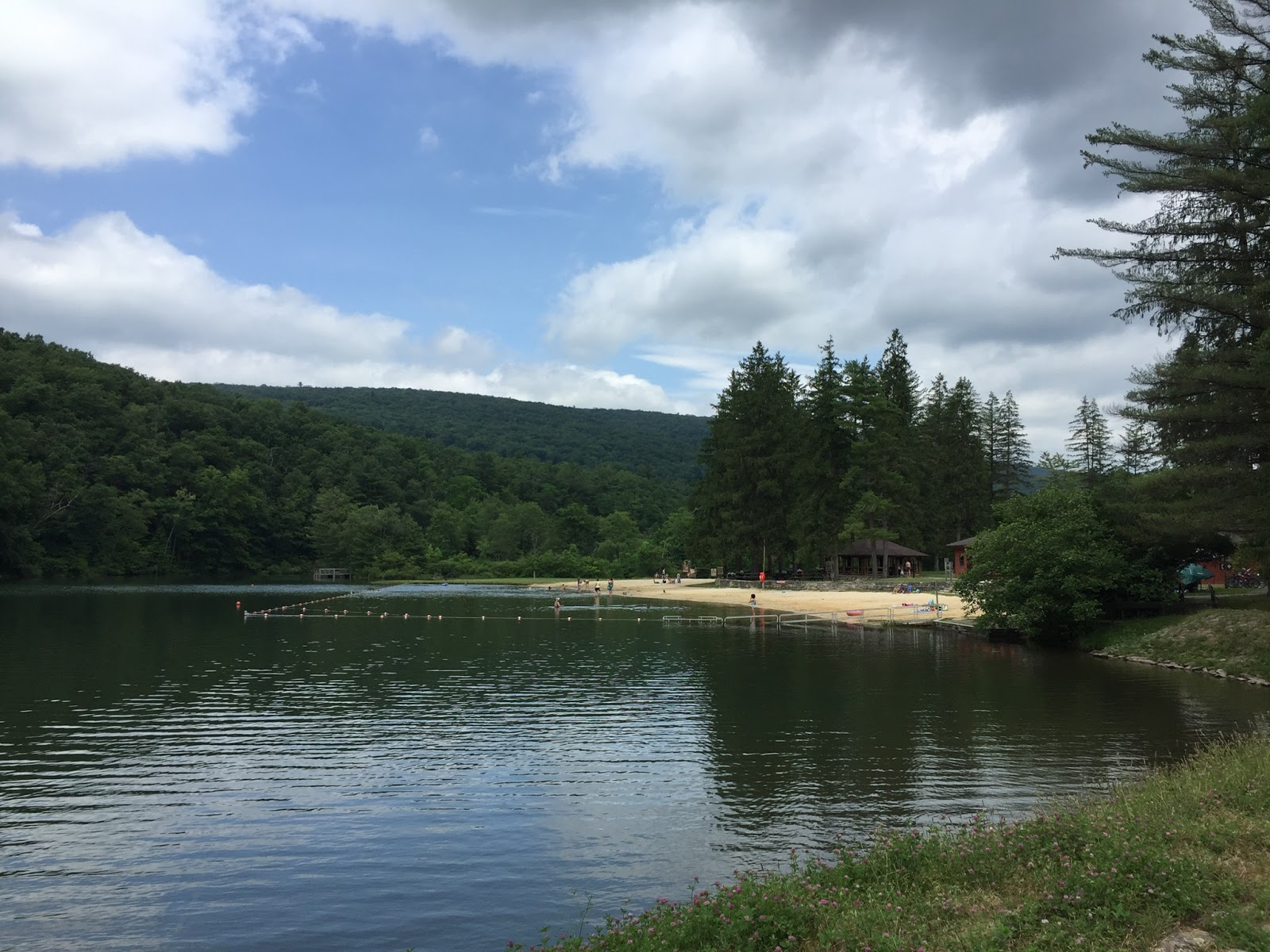
Like you, O reader, most of my dreaming and scheming about outdoor destinations is done online.  Isn't that what brings you to my obscure and rarely-updated blog anyway?  The advantage to online research is that you can find photos, and websites, and Google reviews of a place before putting in the time to investigate it for yourself.  But one glitch is that reading about places online can cause you to build up false expectations about them.  I don't say this with any sort of disappointment, but I added four new state parks to my collection on this recent trip to central Pennsylvania, but none of them impressed me all that greatly.  Pictured here is Greenwood Furnace State Park, which has it all: a beach, hiking trails, a campground, several historical displays, a gift shop.  I liked it.  But I wouldn't have driven three hours just to be here.
I also visited the notoriously remote Penn Roosevelt State Park while I was here.  It can only be accessed by way of gravel lanes that wind through the Rothrock State Forest.  I'd always imagined it as a sort of outdoorsman's paradise.  There's nothing there but a pond, a small campground (with sites that cannot be reserved), and perhaps the most isolated public restrooms in the state.  No electricity, only tent-camping, no playgrounds, or ranger stations, or showers.  It's nice as car-campgrounds go, but it's mostly just that: a campground deep, deep in the woods.  There was nothing to film there except a few picnic tables under trees.  In fact, there was not a single occupied campsite on the day before July 4, though a friendly young ranger showed up and suggested sites 11 and 12.  There was nothing to photograph at Reeds Gap State Park either--which for some reason had an enormous number of parking lots and very little else.  At least its pleasant, woodsy little campground was filling up.  And at Whipple Dam, the fourth state park that I added to my collection, there was little besides a beach that closes at dusk.  Plenty of people.  Because the romantic myth of Penn Roosevelt's wilderness acclaim was a little dissipated by an actual visit to the place, I decided not to push on to discover the equally mystical Poe Valley and Poe Paddy state parks.  Some illusions are best when they're maintained.  However, I did go to the Outer Banks again last month--a place that I'm only just starting at last to appreciate.  Photos from the North Carolina coast can be found here and here.  Photos of various places around the state, including the mountains near Asheville, are here.  

Old Stone Church, Greenwood Furnace

Sacred architecture has always fascinated me.  And I've always been particularly intrigued by the old stone church at Greenwood Furnace State Park in central Pennsylvania.  It once functioned as a regular church, back when there was a village built around the old "furnace."  It then fell into a long season of disuse, and now it is used as a church again but only in the summertime, when campers can attend services.  It's run by the local Methodist ministerial association--or whatever.
The stark simplicity seen in these photos has a whole different feel when you're actually standing inside the church.  In pictures, it looks a little dull, homespun, uninspired and uninspiring.  But in real life, there's a real peace and tranquility to this place--which surely used to ring loud with the Methodist revivalism of the 19th century.  There were musty Methodist hymnals in the pews and paraphrased versions of the Bible.
Click on this photo to enlarge it.  I loved the scene with the two pianos, the bottle of water on a stool, the meadow just outside the window.  It's a still life of rural American spirituality.  On the piano bench, unseen, one of the old red hymnals was laid open on its face to a pair of hymns I had never heard of.
It's the attempt to differentiate the sacred from the secular that I regard as admirable in so many rural churches.  They're clearly simple places with down-to-earth people, unpretentious, perhaps less educated.  But they still go to the effort of rounding the top of this window into a gentle arch, just to remind you that this place is not your kitchen, or your barn, or even your fancy parlor.  This place is sacred.  It's a church, a place set aside from daily life, a place whose presence in the community is meant to remind us of the best ideals of humankind, a place pointing toward goodness, truth, and beauty.  Of course, churches are fallible human institutions, and especially in the age of Trump, their moral authority is more than a little tattered.  But at least their physical presence aspires to represent better things, the noblest elements of humankind.  
All church mice are poor, but none poorer than the ones at Greenwood Furnace Church where they're desperate enough to eat paper.  (I was known as The Snowbelt Parson in years past.  For a reference to eating books, see Ezekiel 3:1 and Revelation 10:10.)
I lingered long in this place.  It has a welcoming, comforting feel to it--despite the cold whiteness of the walls and pews.  I doubt I'd want to hear anything coming from a rural Methodist pulpit.  Their denomination has recently come out strongly homophobic, and they're conducting witch hunts to purge their ranks of gay and gay-friendly clergy.  But it was a nice place to be alone for awhile.  

Standing Stone Trail: Section 8

 With my entire family out of the country, I fled to the hills and did my first-ever overnight on the Standing Stone Trail.  Arriving at about 6:30pm on Tuesday and heading home at about 12:30pm on Thursday, Independence Day.
 The evening views out over the wide farming valleys of central Pennsylvania were well worth a three-hour drive from Pittsburgh.  This is looking east toward the tidy, quaint little borough of Belleville, where all the houses are stately and as big as high schools, and there are nearly as many Amish buggies as there are pickup trucks.
 I took a little gravel lane out of the hamlet of Allensville and up onto the mountaintop to meet the trail. But the trouble with Stone Mountain is that, though it's state forest land, and you’re allowed to camp almost anywhere on its ridge line, the pitch is so steep and rocky that there aren’t many places you could pitch a tent.  I did manage to find a level area with a fire ring just north and downhill from a rock feature known as The Wall—which commands a nice view westward and is a good place to watch the sunset.
 An even better westward panorama can be found at Sausser’s Pile, the enormous heap of boulders pictured here.  As evening came on, both nights, a number of wood thrushes and one distant owl sang their benediction over the dark.  The evensong of the forest.  No night in the woods is completely satisfying without it.  Otherwise the woods up there on the mountaintop was hushed, almost reverent.  It got quieter the later it grew.  The many flies and mosquitoes seemed to go to bed early.  There was none of the usual weirdness about sleeping out in the forest alone.  You know, the nighttime thoughts that solitude brings on--is there a bear nearby; is someone watching me from behind a tree?  This place has a profound peace to it.
Even though I was here over July 4, and the nearby state parks seemed to have attracted crowds (with the exception of Penn Roosevelt, to be mentioned in a future post), I met not another soul on the Standing Stone Trail.  I do not go to the woods to meet people, and it was glorious to have this magnificent place all to myself.  But it made me wonder a bit.  Where are all the people?  Shouldn't there be more than a single hiker out on the 4th of July weekend?
Again, this is the view from Sausser's Pile, which might have been my favorite spot on that stretch of trail.  I loved the way the clouds cast shadows over the canopy of the forests in the valley below.  It was hot, crazy hot, though far less hot up on the summit.  The clouds didn't seem to move at all.  They just hung there like formless sculptures in the sky.
I did break a backcountry rule by spending two nights in one spot, since camp sites are so hard to come by on this steep and rocky terrain.  I want so badly to do the whole trail, but I'm afraid.  Even just two nights out there were pretty grueling in the kind of heat we're having.  I wanted a brook-bath so badly both nights, but had to use disposable bath wipes for the absence of any streams.  (Those little wipe-things couldn't begin to wash away the dirt and smell!)  And because water is so scarce on ridges, I had to pack it in, which added a lot of weight to my pack.  I was shocked and dismayed to learn that it's only two miles from Allensville Road to the Little Vista (first photo).  It truly felt more like five miles to me.  It's not just age.  I'm only 49.  It's an old family banshee that I'll just call "the palsy," eating away at me more rapidly than I'd expected.  I wonder if I'll ever do this whole trail.

Tuesday, June 4, 2019

The Beauty of Forgotten Things: Hillman State Park

 It’s been a good long while since I’ve taken my deep thirst for the outdoors, my never-ending quest for beauty and adventure, to the old reclaimed strip mines at Hillman.  The poison ivy, the deer ticks, the thin forests with brittle canopies.  It’s just not the land of hemlocks and ferns that I love.  Instead of deep shade and trickling trout streams, Hillman has broad grassy meadows, piercing sunlight, spooky groves all in tatters.  Ah, but I’m glad I went there this past Sunday.  It seemed to be as quiet and as beautiful a place as I could desire.
One nice thing about visiting a park rarely is that you forget what you once learned about it, and you get to rediscover it—which I probably say every time I go to Hillman.  It’s even closer to my house than Raccoon Creek, and I didn’t have much time, so I made it my destination of choice.  It was lovely in the light of early evening, with the summer all fresh and green, the trees as-yet-unplagued by wilt, or drought, or disease.  Someone has begun to name the trails in this park and even mark them with signs, which is at once a help and a sorrow.  It’s a help for obvious reasons.  It’s a sorrow because the place no longer has the dangerous character it had back when it was easier to get lost there.  The Wetlands Trail wends between at least five scenic ponds that were devoid of all fishers on a Pirates home game day.  The only fisher here was an elegant blue heron.  Imagine this place just before sunset, when the wood thrush makes his evensong.  

Monday, April 8, 2019

West End Overlook, Pittsburgh

This much-neglected blog is evidence of my too-busy life.  Even if I do still get an excursion out into the woods or the world every week or so, I no longer take the time to document it.  And yet, on my way home from my therapist's--what?  Therapists don't really have "offices," do they?  Is it a den?  A parlor?  It has the feel of a room in a quiet European movie: urban, with lots of big windows, books, and plants, and the refined paraphernalia of an educated and privileged life...a framed Chaucer quote, strange little statues of dancing women, far corners filled with shelves and doors as inaccessible as Jerry Seinfeld's bedroom.  (Remember, all you ever saw was the hallway to it.)  In any case, on my way back from my therapist's cinematic chambers in Shadyside, I got the urge to stop by a place that I haven't seen since I was in college.  The West End Overlook!
Another factor contributing to my neglect of this blog is that I now see my therapist on my days off, which gives me less time to get all my work done around the house.  By the end of the day, if I was lucky enough to get a hike in, it was almost always someplace nearby, a place that bores me too much to talk about.  I hope to start doing weekly exploration once again, but I'm not sure when.  The West End Overlook is nice.  It definitely has better views than Mt. Washington.