Click on these photos (as always) to enlarge them. You can barely discern the old city steps as they pass through the thickets. Notice the blue and white street sign in the middle of the photograph. This is China Street, a public thoroughfare.
You can run a MapQuest search for "China Street, Pittsburgh," and it will zoom you straight to this spot...just near the Old Stone Tavern (below). Funny how MapQuest treats this overgrown staircase as if it were an actual roadway, something travel-worthy and capable of supporting your contemptible SUV.
In Pittsburgh, "city steps" are still relatively common. A public street can become a public staircase in places where the grade is too steep for regular traffic. This place was given up on long ago, but the street sign doesn't actually look that old.
Established in 2010, SNOW AND JAGGERS is a photojournal of historic, scenic, or forgotten places in Pennsylvania.
Wednesday, February 20, 2013
Old Stone Tavern, Pittsburgh
In a gritty corner of the city known as the "West End Valley" sits an isolated urban village containing perhaps the oldest building west of the Allegheny Mountains. The structure's cornerstone lays claim to a construction date of 1756, and the sign on the now-defunct bar also boasts "Established 1756." Just a refresher in local history: General Edward Braddock tried and failed to capture Fort Duquesne (Pittsburgh) from the French in 1755. General John Forbes succeeded in 1757 and founded the British outposts of Fort Pitt and Pittsburgh. It seems almost inconceivable that a two-story stone inn was constructed just west of the French fort in the interim between the two military campaigns, at the very beginning of the French and Indian War. And yet, if this old house is not lying about its age, then it is a full eight years older than the Fort Pitt Blockhouse, which carries the official designation of "oldest building in the city" and region. The old inn stands derelict with broken windows and crumbling walls.
In the upper photo, notice that the inn sits at the corners of two of the oldest roads in the region: Greentree Road and Woodville Road. There was a prominent early inn whose name appears frequently in old histories of the city: "The Sign of the Green Tree." I don't know if this building was the once-famous Green Tree Inn, but it wouldn't surprise me. After all, it stands at the head of Greentree Road, on the edge of the Borough of Greentree. As for Woodville Road, it is little more than a ghost of its former self. Industrial development has obliterated Woodville Road, all except for the few scant meters shown here. My guess is that Woodville Road ran from this spot--an inn on the westernmost reaches of the British Empire--down to Woodville Plantation, another of the oldest buildings in the region. Even if the Old Stone Tavern was not constructed in 1756, it is certainly a product of the 18th century. Firm records of it appear in the annals of the Whiskey Rebellion, which took place in the 1790s. Tragically, here it sits on a busy, ugly corner, empty and forlorn, returning to the elements. I've said it many a time: Pittsburgh is an unsentimental city. Historic significance and beauty will do nothing to get a place protected and preserved.
Some smart-ass painted the old stones red, probably in an effort to protect them from erosion. Who owns this place? Can nothing be done to save it? It's true that the chimneys lean a little inward. I wonder if structural problems make the place unusable.
In the upper photo, notice that the inn sits at the corners of two of the oldest roads in the region: Greentree Road and Woodville Road. There was a prominent early inn whose name appears frequently in old histories of the city: "The Sign of the Green Tree." I don't know if this building was the once-famous Green Tree Inn, but it wouldn't surprise me. After all, it stands at the head of Greentree Road, on the edge of the Borough of Greentree. As for Woodville Road, it is little more than a ghost of its former self. Industrial development has obliterated Woodville Road, all except for the few scant meters shown here. My guess is that Woodville Road ran from this spot--an inn on the westernmost reaches of the British Empire--down to Woodville Plantation, another of the oldest buildings in the region. Even if the Old Stone Tavern was not constructed in 1756, it is certainly a product of the 18th century. Firm records of it appear in the annals of the Whiskey Rebellion, which took place in the 1790s. Tragically, here it sits on a busy, ugly corner, empty and forlorn, returning to the elements. I've said it many a time: Pittsburgh is an unsentimental city. Historic significance and beauty will do nothing to get a place protected and preserved.
Some smart-ass painted the old stones red, probably in an effort to protect them from erosion. Who owns this place? Can nothing be done to save it? It's true that the chimneys lean a little inward. I wonder if structural problems make the place unusable.
Wednesday, February 13, 2013
Ashes, Ashes...
A frozen lake beneath ashen skies, fitting enough on this Ash Wednesday.
An old roadway, once public, now sees only hikers and horses.
This old spring, adjacent to the road, is barely visible in the gray landscape, beneath the gray skies.
A mossy lane through the hills, once known as McKenzie Road. In places the tarmac is still intact.
The Lakeside Lodge seems to be occupied year round, and I can see why. It would be the perfect place in late winter to meditate on the fleetingness of life. Do you suppose that's why people book it?
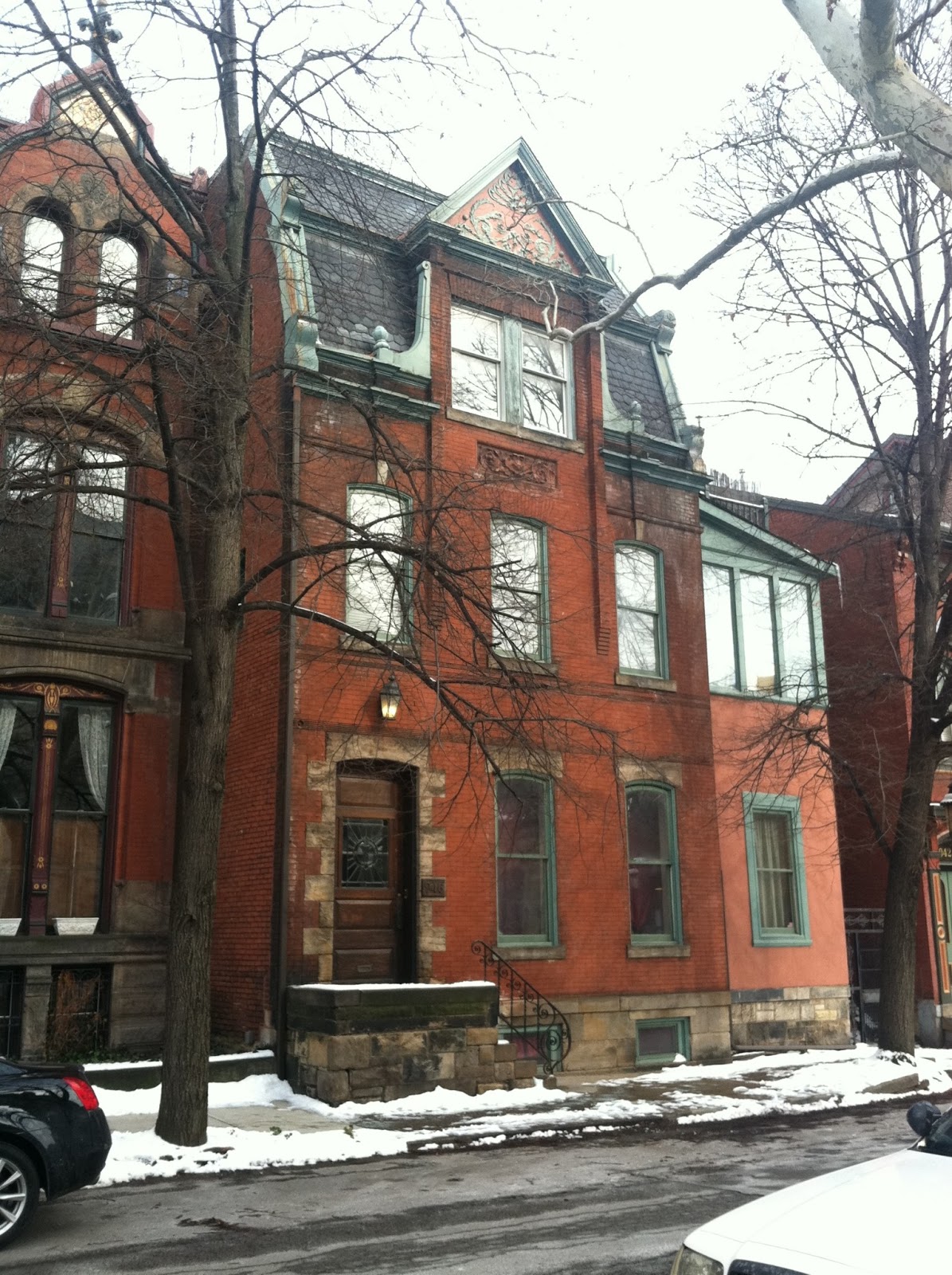
North Side Townhouses, Pittsburgh
For as hip as these North Side home refurbishers are, a surprising number of them still have their Christmas decorations up.
If you had to live in the city, this would be the way to do it.
This little enclave of restored townhouses is just off Allegheny Avenue.
I love a big porch, but would you really use it if you lived in town?
Some of these old structures are built for crowded conditions, but stand alone.
Oh, are we in America? I hadn't noticed. I think these flags really ruin the aesthetic of the block.
The photo is washed out, but this is one of my favorite houses in the city. Get a load of those lion statues at the entrance.
Wednesday, February 6, 2013
The Fool Multitude
This bird's nest, covered in snow, sits right at eye-level along the Heritage Trail. What kind of bird aims so low in life? Why would any avian creature--capable of flight--choose to make its home within such easy reach of humankind? It must be a martlet...except that they only exist in medieval heraldry. Walking past this nest made me think of a line that I haven't recalled in a decade and a half from The Merchant of Venice:
"What many men desire?" That 'many' may be meant
By the fool multitude, that choose by show,
Not learning more than the fond eye doth teach;
Which pries not to the interior, but, like the martlet,
Builds in the weather on the outward wall,
Even in the force and road of casualty.
I will not choose "what many men desire,"
Because I will not jump with common spirits
And rank me with the barbarous multitude.
~William Shakespeare
That's one of the reasons I go hiking; it helps me to reclaim parts of myself that I would otherwise forget, like the fact that I was once a literary snob who sneered at "jumping with common spirits."
Cabins for Rent at Raccoon Creek
It takes a little while for the forest to begin its healing work in a person's spirit. Today, when I parked and began the uphill hike toward the connector path that joins the Camp Trail to the Heritage Trail, I found myself resisting the very thing I needed. I didn't like the way the woods felt. It was unexciting, drab, sinister. Despite the fact that I look forward to Wednesdays all week long, I found myself wanting to get back in my car and go home. I was like a starving man who can no longer endure the very thing that can make him well. Fortunately, I know all about that initial resistance, and I know that you have to push past it. Whether you're hiking, or meditating, or even taking a swim in cold water, there's always that initial adjustment when your lazy self wants to go back to its easy ways. In a few moments, all is well.
Today's trek was a 4.3 mile loop in western Raccoon Creek that begins at the Heritage Trail, runs awhile on the Buckskin Trail, and returns by way of the Camp Trail. The stretch of forest along the Heritage Trail was unfamiliar territory, which is always a bonus. Plus, I got to poke around the "modern cabins" that the park rents out year-round. I don't know if the old CCC-style cabin in the top photo is still available for rent, but this pleasant little cottage with the wraparound porch sure was calling out to me. Too bad my dissertation is finished; this would have made a perfect writing retreat in the heart of winter. These cabins don't have fireplaces, but there are few things I like more than a wraparound porch. Note to self: Cabin # 6 is the most isolated. In "non-peak" seasons, it's $55.66 per night for a PA resident, from Sunday through Thursday, if I understand the byzantine price listing on the PA DCNR website... An interesting old CCC camp is rotting back into the forest in the area just behind the modern cabins. Though remote today, this was once the center of the old, original park that the federal government created here.
I know what you're thinking. I do. And you're right. Raccoon Creek State Park looks just like the Allegheny National Forest. I mean, upon closer inspection, there are more beeches, hemlocks, and maples up north. And the trees tend to grow taller up there, making a denser forest with a higher, heavier canopy. Down here, there's way more poison ivy and far fewer ferns, too. But really, if you were from Thailand or Turkey, you wouldn't be able to tell the difference between the two, especially in February. Then why can't I forgive Raccoon for not being the Allegheny? It just takes time.
A person from Washington State or South Florida would look at these pictures and think, "Bare branches, snow, tree trunks, so what?" And yet, I can't get enough of places like this. I've begun treating Raccoon in the same way I treat the ANF. I deface my maps. I use different colored highlighters to indicate various treks. I write the mileage for each trek and the estimated number of hours and minutes needed to complete the trek. I make note of territory that I've covered and the areas that still remain unknown. The planning and the intentionality add to the sense of anticipation.
Friday, February 1, 2013
Scenes from the Allegheny National Forest
The snowy winterlands of the Kinzua Valley.
Woodsy Owl? The ANF is a land of ghosts. I haven't seen this guy in years.
Look closely. This is where US Forest Service picnic tables come to die, the Valley of Dead Tables.
These crevices are called "hollows." They're just wrinkles in a mountainside, descending toward a stream.
Sometimes, in the forest, I'm mesmerized by the vision of dark trees standing against the snow--erect, slender, grim. It reminds me of a painting I saw long ago, a painting that I'd like to see again, but I have no idea where to find it. In some sense, that painting made me long for the winter woods...and now the winter woods makes me long for the painting.
Subscribe to:
Posts (Atom)